
Retaining Manual Workflows Until Automation Clears the Payback Threshold
Many early-stage SaaS teams should retain manual outreach until an API integration clears a measured payback threshold. Automation is a strict investment decision requiring verifiable returns, not an assumed operational upgrade. The team first records the current manual workload, then tests the proposed integration against three gates: realised labour savings, attributable incremental gross profit, and complete implementation cost.
Teams set a defined evaluation horizon, typically 6 to 12 months, and include only the value realised inside that period. Assess the labour release, gross-profit gain, and total investment separately before combining them into a final return on investment result. A reduction in manual errors only matters if it translates to measurable financial gain within this window. Automation is approved only when the conservative case clears the organisation's return and payback thresholds; otherwise, the measured manual workflow remains in place.
Defining the Direct Return Boundary for Email APIs
The measurement boundary must be fixed before collecting benefits. A direct-return boundary values only removed expenditure, named productive redeployment, and attributable gross profit within the dated evaluation horizon. Vague benefits such as appearing more sophisticated are excluded entirely.
The core model calculates net benefit by adding incremental gross profit, realised labour savings, and avoided costs, then subtracting implementation and recurring costs. Return on investment is this net benefit divided by the total investment. Convert attributed revenue to gross profit using the product's documented cost-of-service or gross-margin input rather than entering revenue at face value.
Accept evidence such as payroll records, task-level time logs, supplier invoices, and provider quotes dated within 30 calendar days of the approval meeting. Calculate payback as the first month in which cumulative realised benefits equal cumulative integration and operating costs. Review this metric monthly across the chosen 6-to-12-month horizon.
Pricing the Baseline of Manual Message Delivery
For 10 to 15 business days, participating staff record time against recipient selection, message preparation, campaign sending, result export, failed-send handling, and error correction. Capture start time, finish time, workflow type, message volume, failure handling, and rework for each observed email run over two to three working weeks. This granular tracking prevents teams from overestimating the time spent on simple batch sends while underestimating the hours lost to investigating bounce reports.
Finance converts those observations to loaded labour cost using the organisation's own payroll-related expenses. Do not import a generic hourly benchmark. Add current email software, export tools, contractor assistance, and recurring correction work only when the integration would cause those charges or tasks to cease.
Calculating the Hidden Engineering Burden of API Sending
Engineering decomposes the build before estimating the effort. Technical discovery and data mapping come first, followed by authentication, template migration, event processing, suppression rules, and unsubscribe controls—all before a single production message is sent. Automated tests, release work, documentation, and operator training complete the initial phase. A security or compliance review is inserted where the SaaS product handles sensitive customer information.
Finance then adds provider charges and ongoing support. Recurring rows cover the provider plan, send or validation charges, overages, monitoring, incident response, template upkeep, and engineering support across the full 6-to-12-month evaluation period. Obtain dated, like-for-like quotes based on the same monthly send range, feature set, retention requirements, and support level. Recheck the selected quote one to three business days before approval.
Model tier boundaries, overage units, and optional services separately because a forecast crossing a plan limit can change recurring cost without any change to conversion performance. Place build contingency on a visible model line and vary it in the conservative and upside cases. Where provider-specific templates, event formats, or suppression features are used, include migration and switching effort as sensitivity inputs rather than assuming a cost-free change.
Isolating Conversions Generated by Improved Delivery
Installing an email API does not inherently raise conversion. Gains usually depend on changes to timing, reliability, targeting, or message design. The measurement owner identifies the mechanism expected to create value before launch. Messages are then followed through the accepted-to-delivered-to-product-action-to-retained-gross-profit chain, split by transactional, lifecycle, and sales email flows.
Track accepted, delivered, bounced, and suppressed messages, then join the eligible recipient to a defined product action, payment event, and gross-profit record through auditable identifiers. Run a holdout or staged rollout for 28 to 56 days where purchase cycles permit. If the normal conversion cycle is longer, continue until both groups have completed the same documented cycle.
Analyse transactional, lifecycle, and sales outreach separately because an account-verification completion, subscription upgrade, and sales-assisted purchase are different business events. Incremental conversions equal observed conversions in the exposed group minus the conversions expected from the holdout or adjusted baseline. Total conversions are never credited entirely to the integration. Open and click data may diagnose message performance, but the financial calculation ends at a margin-bearing event. Any reported first-party result must state the test dates, included flows, allocation method, attribution window, and known gaps such as missing cross-device tracking. These measurement frameworks isolate direct financial returns, but they cannot account for unrecorded offline sales touches.
Consolidating Manual and Automated Workflows into a Single Financial Model
The analyst places the manual and API paths in one model using the same evaluation horizon. Editable model rows include manual labour, existing tools, engineering build, security review, migration, training, recurring provider charges, maintenance, incident work, realised time savings, avoided costs, and incremental gross profit.
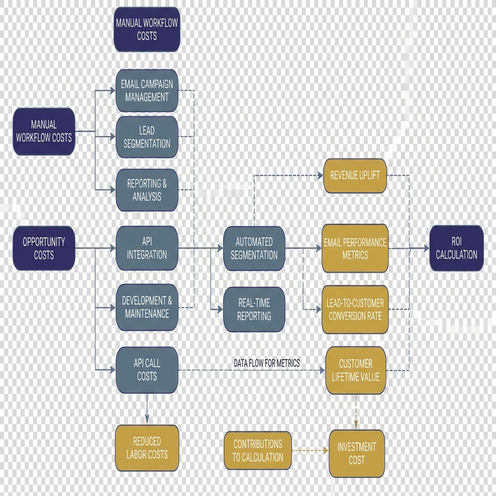
Use labelled placeholders rather than benchmark numbers: [observed monthly hours] × [loaded hourly cost] × [realised redeployment share] for labour value, and [incremental paid conversions] × [gross profit per conversion] for conversion value. Net benefit equals total realised benefits minus total investment, while ROI divides that net benefit by the total investment. Payback is the first dated period in which cumulative benefits are at least equal to cumulative costs.
The base case uses the best-supported inputs. Conservative and upside cases alter only documented uncertainties such as engineering effort, send volume, productive redeployment, and measured conversion lift. Hold verified inputs constant across scenarios. Change only variables with recorded uncertainty ranges, preserving the source, owner, and evidence date beside each variation. Review monthly cash movement over 6 to 12 months so an acceptable period-end ROI does not conceal an unaffordable build and migration outlay in the first 30 to 60 days. The decision owner checks whether the conservative case clears both the required ROI and the maximum payback period.
Authorising a Pilot, Full Integration, or Continued Manual Operation
The decision group selects among three outcomes from the model. Irregular volume with little realisable saving supports continued manual operation. Where attribution stays uncertain, a limited pilot with a named flow and measurement plan is the safer call. Repeatable conservative-case savings support a broader integration.
For a pilot, define one email flow, eligible recipients, conversion event, gross-profit source, holdout or staged-release method, and a 28-to-56-day measurement window before engineering begins. Record the decision and lock a dated baseline on the approval day. Perform initial cost and delivery checks after 30 calendar days and a fuller benefit comparison after 90 calendar days.
At a Friday planning meeting, a SaaS operations lead replaces a hopeful automation pitch with 10 business days of task logs, a provider quote dated that week, and finance-owned gross-margin inputs. Because conversion attribution remains unresolved, the group authorises only one lifecycle-email pilot and records its holdout design before any build work starts.